

AdonisFX: Any Character, Any Style
Simulation for Cartoon Animation.
AdonisFX: Any Character, Any Style
Simulation for Cartoon Animation.

Anatomically-driven simulation tools like AdonisFX, Ziva Dynamics, and Houdini are well-known approaches for making characters look realistic and believable. But what about using these tools for ‘toonish’ characters? It would be great to have an extra level of detail available that helps enhance certain parts of the character’s performance, making the animation more alive without taking away the cartoonish qualities that really matter in a performance. Unfortunately, getting simulation tools to behave as needed in such a different context is difficult. Or is it?
Check out this video showing an AdonisFX simulation applied to the Beta character from Agora.community:
Many thanks to Agora.community for allowing us to use the fantastic Beta character (the original asset can be downloaded here). Check the end of this post for details on how to download the full AdonisFX setup for Beta (Maya only).
As you can see from the loose vs tight versions of Beta, we are able to control the character’s simulation behaviour and get a performance that really benefits from the addition of simulation. In fact, AdonisFX can control the simulation by frame (something our customers love) - this isn’t just a blanket addition of dynamics.
This character’s simulation setup was built with standard AdonisFX 2.0 in a matter of hours, and without ‘fighting’ the tool. Persuading a realistic simulation tool to behave with unrealistic characters and motion is hard. We’ll explain why AdonisFX is able to handle this, but first, let’s explore why it’s so difficult to use simulation tools on toon characters.
Why is anatomical simulation tough on toons?
When artists and technical directors say something like the simulation ‘blew up’ or ‘exploded’, they are describing how a character’s pose and/or motion is causing the simulation to fail to converge on a satisfactory result.
Typical challenges include:
Extreme poses i.e. squash, stretch, hyperextension, and the variations in volume that come with them
Extreme velocities (including sudden changes in direction)
These challenges are natural when you consider what digital anatomy solvers are typically designed to handle: photorealistic, anatomically plausible behaviour of tissue. This means that certain base assumptions are made about use cases that help to improve outcomes, streamline development, and optimise performance.
What do we mean by ‘base assumptions’? Well, let’s think about a ‘photoreal’ creature and what you might expect of its anatomy vs what a toon character might need:
Anatomical solvers are designed around the expected joint ranges of a ‘real’ creature. Squashing, stretching, hyperextending etc are all staples of toon character animation, but they break many of the assumptions about ranges of motion that are built into the simulation solvers.
Digital tissue is parameterised for human-ish motion. Extreme velocities and instant changes in direction generate enormous inertial forces, and a dynamic solver will either explode, introduce unwanted jiggle, or damp out exactly the snappy timing the animator wanted.
Real flesh is near-incompressible (at least if you want the creature to stay breathing!). A toon character is very different, its volume is constantly changing. Anatomical solvers make assumptions about volume preservation that cause them to struggle when asked to handle something outside of those expected norms.
AdonisFX is certainly built around these same assumptions, yet the video shows that it can work very well with a toon character that’s exhibiting extreme poses, extreme velocities, and big changes in volume. So what's going on?
AdonisFX: it’s all iterative
The answer lies in how AdonisFX solves its simulations. Most anatomical solvers use a monolithic numerical approach where the entire system of equations must be solved simultaneously and the solution must be physically exact. Think of it like a massive system of simultaneous equations where every variable depends on every other variable and there is only one correct answer. This works well within the expected operating range of realistic anatomy, but when extreme poses and velocities push the system outside that range, the solver struggles to find valid solutions and the results break down.
AdonisFX takes a fundamentally different approach. Our solvers are iterative, meaning they work toward a solution over a number of iterations, getting progressively closer each time. If the solver runs for ten iterations and hasn't fully converged, it simply returns the best result it has. It never forces an exact solution, which means it rarely blows up, even when conditions get extreme. The system is inherently permissive rather than brittle.
On top of this, AdonisFX solves in layers rather than all at once. Each muscle is free to solve independently without needing to account for everything else in the system at the same time. Only after the individual elements are stable do we compose them together through the fascia and fat layers. This keeps each piece of the puzzle locally stable and avoids the combinatorial complexity that makes monolithic solvers fragile under stress.
As previously discussed in the AdonisFX and FEM article, we designed Adonis around the requirements of media production: making great looking characters for film, tv, and video games. This focus means that certain interactions between elements are approximated rather than precisely computed, as that level of physical precision simply isn't needed. The payoff is stability, artistic control, and speed/performance. It also means that we can apply AdonisFX simulation to toon characters and get great results.
Deep dive with Marco
Inbibo’s founder, Marco Romeo, goes into much more detail on the setup in this overview.
If you want to ask questions or give feedback, you can check out our forum post here.
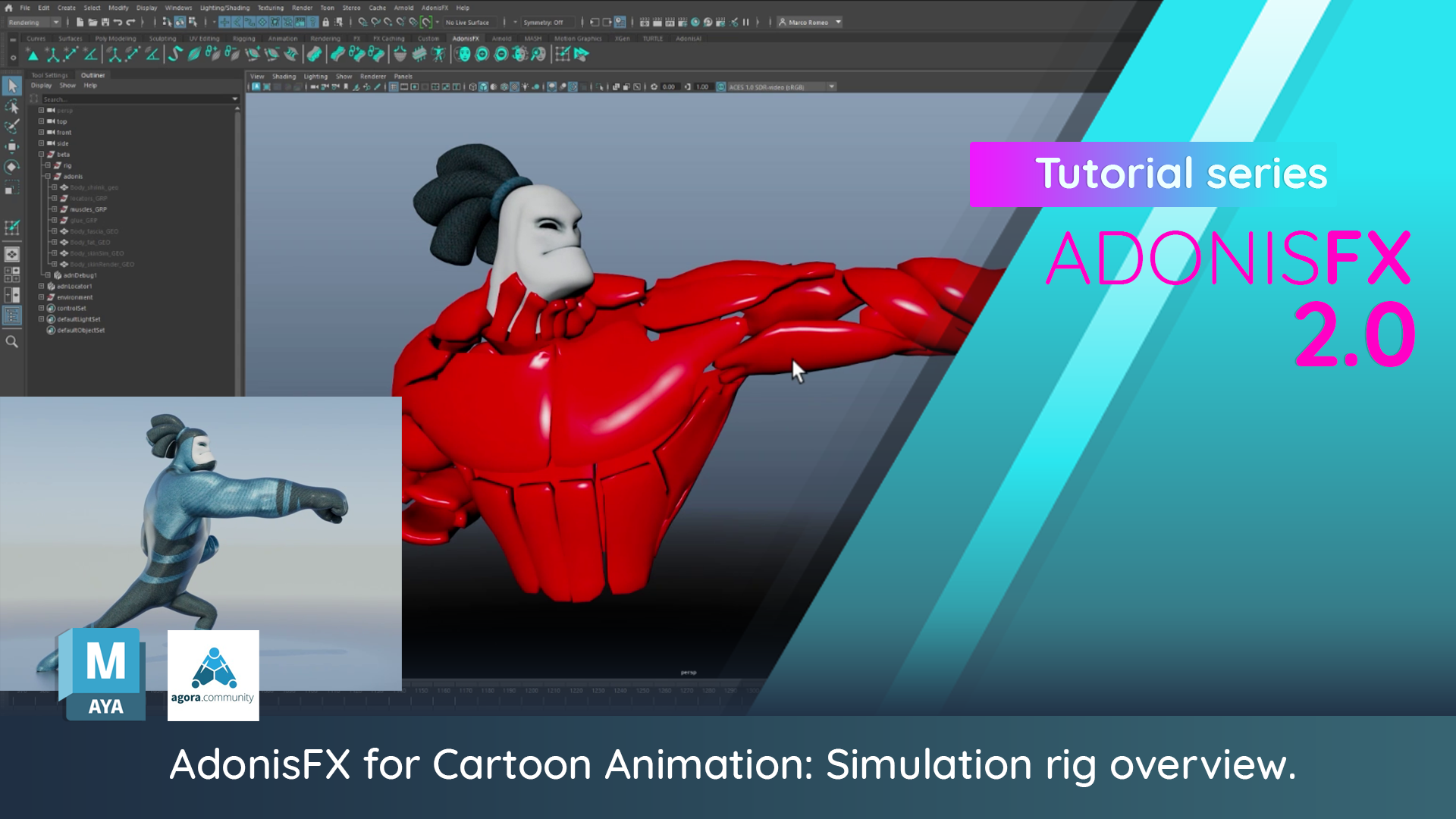
Marco provides an overview of how AdonisFX can be applied to cartoon characters to enhance their dynamism through simulation.
Try it for yourself
Download an AdonisFX version of the Agora Beta character today. Instructions for how to run the setup in Maya are included in the download files.
AdonisFX has a free 30-day trial - just download the software, install it, and you’ll get started right away.