

Houdini Python API
Experimental Python API
This API is experimental and may change in future versions of Adonis.
The use of this API in production applications is not supported.
An experimental Python API is available for Technical Directors who need to implement custom Python scripts for exporting and rebuilding Adonis rigs programmatically.
This API enables users to:
- Extract the setup from an existing Adonis rig in Houdini.
- Rebuild the rig in another Houdini scene.
- Export rig data in a format that can be imported into other DCCs, such as Maya.
- Build an entire Adonis rig programmatically.
As this API is still under active development, please send feedback and feature requests to [email protected]. The support and development teams will work together to incorporate user feedback and refine the implementation.
The API can be found in:
Adonis/python/adn/api/adnx.py
The definitions can be imported with:
from adn.api.adnx import *
The API exposes Adonis rig entities through Python classes and type identifiers. The available classes, supported data entries, and implementation details are defined directly in adnx.py.
Requirements
Before using the Houdini Python API, the Houdini scene must follow the expected Adonis rig structure.
A Houdini context must be defined with rig.setContext("/obj/geo1"). This tells the API which Geometry context should be used to extract or rebuild the rig.
Rig components in Houdini must live directly inside the Geometry context. Encapsulating Adonis SOP nodes inside subnetworks is not supported.
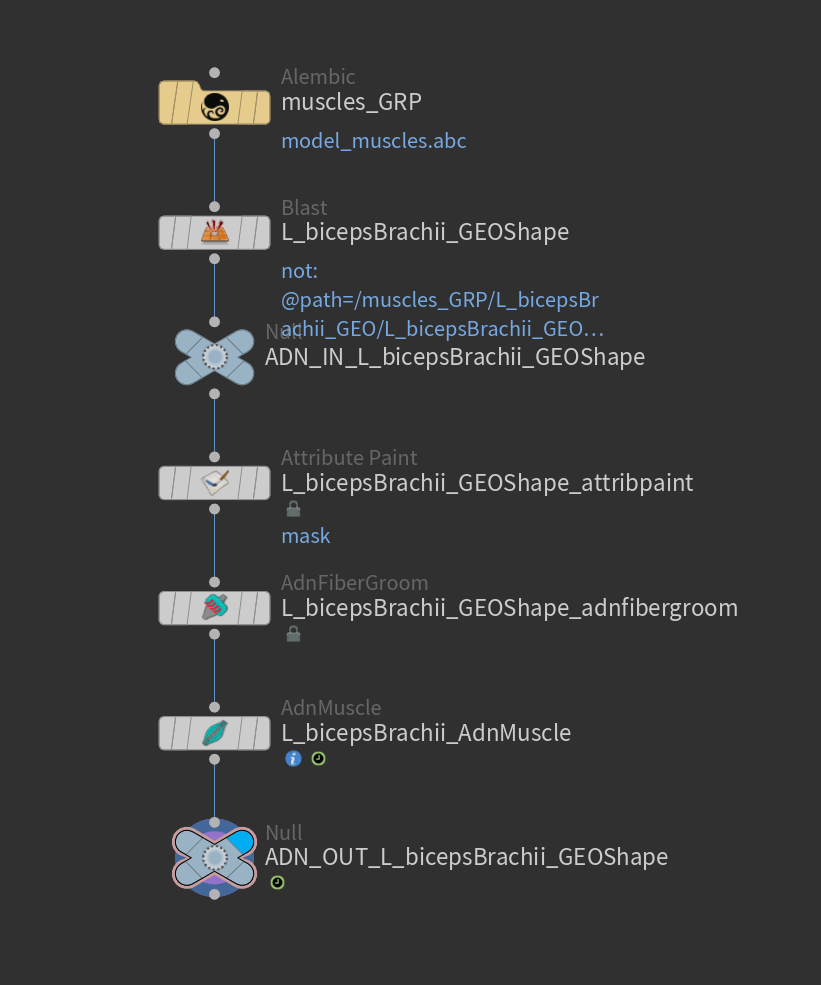
Each geometry to be deformed must be separated and encapsulated in a deformable region using two Null nodes prefixed with:
ADN_IN_<geo_name>ADN_OUT_<geo_name>
The <geo_name> value should match the expected shape name counterpart in Maya.
The API uses these deformable region Null nodes to identify the geometry name associated with Adonis SOP nodes. When extracting data from Houdini, the API first looks for an ADN_IN_ node upstream of the Adonis node, and can also use the corresponding ADN_OUT_ node as a fallback.
Nodes used to drive attachment to transform or slide on segment constraints, such as Null, joint, or rivet nodes, must live in the /obj context.
To ease the process of separating geometries, use:
Adonis > Utils > Separate Geometries
This tool works when there is a valid piece attribute on the geometry stream, such as path, name, or muscle_id.
Basic Usage Examples
The method definitions may change before the API becomes production-ready. The following examples show how to use the current experimental Python API for Houdini.
Create a Rig Instance
Create a rig instance with Houdini as the host:
rig = AdnRig(AdnHost.kHoudini)
Set the Houdini Context
Set the context where rig information will be gathered or created:
rig.setContext("/obj/geo1")
The context must be a valid Houdini node.
Create a Rig Component
Create an Adonis rig component and add it to the rig. For example, to create an AdnMuscle component:
muscle = AdnMuscle(rig)
rig.addSolver(muscle)
Some components are added automatically when they are created with a rig instance, depending on their base class. However, explicitly adding the component to the rig can help make the workflow clearer.
Extract Data from an Existing Node
Gather data from an existing Adonis node in the Houdini scene.
For example, if an AdnMuscle node named AdnMuscle1 exists in the current Houdini context:
muscle.fromNode("AdnMuscle1")
Get Extracted Data
Get the dictionary containing the extracted data:
data = muscle.getData()
The returned dictionary contains the component parameters, maps, connections, node information, and other data required to rebuild or update the component.
Populate a Component from a Dictionary
Populate a rig component from a dictionary that contains all required entries:
muscle.fromDict(data)
The required dictionary formatting can be found in the __init__ methods of the corresponding classes, for example AdnMuscleBase and AdnMuscle.
Modifying dictionary entries allows users to update or rebuild rigs with custom values.
Update an Existing Component
Update an existing rig component in the scene after modifying its values:
muscle.update()
This method assumes that the target Adonis node already exists in the Houdini scene.
Build Rig Components
Build a single component in the scene:
muscle.build()
Build all components registered in the rig:
rig.build()
Define the Execution Order
Define the execution order when extracting data from an existing scene:
rig.buildExecutionOrder()
With an already configured scene, this deduces the reconstruction order required to preserve deformation order and node dependency chains.
The execution order is built from:
- Sensors.
- Non-deformable utility nodes.
- Deformers and solvers in deformation chain order.
Clear a Component
Clear a specific rig component from the scene:
muscle.clear()
In Houdini, clearing a component deletes the corresponding Houdini node. This operation is only expected to work when the network is not cooking.
Connections
The API can extract and rebuild connections between Adonis nodes.
In Houdini, connections are represented through parameter expressions. The API supports:
- Detail attribute connections.
- Channel reference connections.
When extracting connections from Houdini, the API searches the evaluated node parameters and converts compatible expressions into serialized connection data.
When rebuilding connections in Houdini, the API attempts to recreate those connections using the appropriate expression type.
Exported connections between Adonis nodes may differ depending on the DCC. This is expected due to differences between DCC applications. However, the rig should be reconstructed correctly when imported into any supported target DCC, as long as the required nodes, geometry, and rig structure are compatible.
Exported Rig Data
The API is the foundation for the Import and Export tools in Adonis.
Below is an example of exported rig data in a .json file:
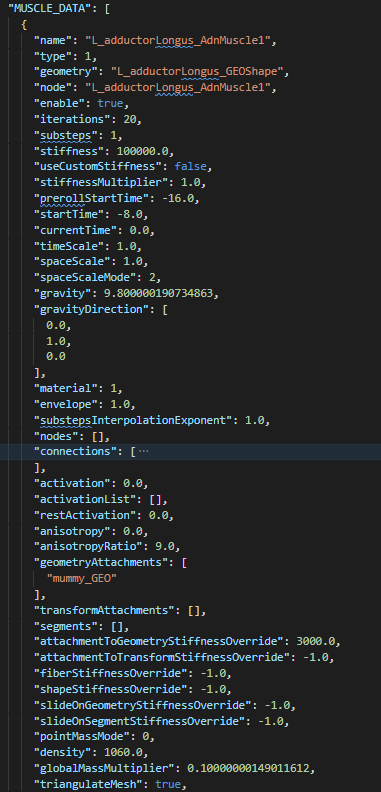
All other methods and data definitions can be found in:
Adonis/python/adn/api/adnx.py
Houdini Network Structure
Houdini rigs require extra nodes to be added for API support.
Each geometry to be deformed must be separated and encapsulated in a deformable region with two Null nodes:
ADN_IN_<geo_name>ADN_OUT_<geo_name>
The <geo_name> should match the expected shape name counterpart in Maya.
Naming and Interoperability
When transferring data between DCCs, some naming conventions must be respected.
Deformed geometry uses the Shape suffix to describe the geometry entry. This is important when moving data between DCCs, because the geometry name must follow the expected naming convention.
Data such as geometryAttachments is represented using the name without the Shape suffix. This is also important for interoperability between DCCs.
The <geo_name> used in ADN_IN_<geo_name> and ADN_OUT_<geo_name> should match the equivalent expected shape name in Maya.
Limitations
- Subnetworks inside the Geometry context are not supported. All Adonis SOP nodes, and any SOP nodes containing geometry required by the Adonis rig, must exist at the same level inside the Geometry context, for example
/obj/geo1. - Nodes used to drive attachment to transform or slide on segment constraints must live in the
/objcontext.